
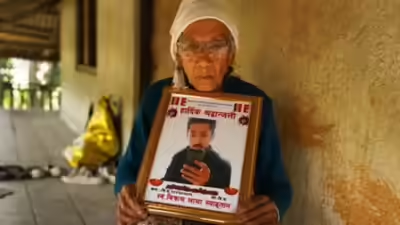
Last week, Guardian Australia reported a 32 year old man from a hillside village in Makwanpur, Nepal. His family sold their highly valued farmland to fund his travel to Australia in 2013, where he arrived to study computer science. In December 2025, he died alone in the bushes near St James station in the heart of Sydney. His body remained there for almost a week, during which time approximately 100,000 people walked past. By the time he was discovered, his remains had decomposed beyond visual recognition, and his elderly mother in Nepal was later asked to provide a DNA sample for identification purposes.
I write this for my clients, and for the hundreds of thousands of others who came to Australia on temporary visas with a structured plan, family waiting at home, and the unwavering hope that hard work would ultimately earn them a permanent place here.
What I need to say is this: the temporary visa system that brought you here was never designed to let you stay. And the longer I practise in this field, navigating complex appeals and visa cancellations, the clearer it becomes that this is not a legislative mistake, but a system working exactly as it was intended.
Australia’s international education sector is a major national asset, worth tens of billions of dollars each year. It actively supports universities, English-language colleges, migration services, and public budgets across the country. Crucially, it depends on a steady, uninterrupted flow of students from India, Nepal, Pakistan, the Philippines, China, Vietnam, Bangladesh, and elsewhere.
Students are told, long before they arrive, that Australia is a country built on migration, that there are clear pathways, and that study, work, contribution, and integration may lead to a secure future here. Many hear that compelling message from education agents overseas; others hear it directly from Australian universities at massive recruitment events. For many, it is a message they accept sincerely, because it reflects the progressive story Australia tells about itself on the global stage.
At the same time, many students arrive with at least some hope that their studies may ultimately lead to permanent residency. Yet the highly strict student visa framework requires applicants to satisfy decision-makers that they are coming genuinely to study and that they intend to leave Australia when their course ends.
That fundamental tension lies at the absolute centre of the system. Where a student later seeks to undertake further study in order to improve their prospects of remaining in Australia, subsequent visa applications may be swiftly refused on the basis that they are said to be using the student visa program as a means of staying in Australia rather than for its intended educational purpose.
When that devastating refusal occurs and no clear lawful pathway appears to remain, some people become highly vulnerable to misinformation, poor advice from unregistered agents, or desperate attempts to use other visa processes in ways not originally intended. That does not excuse misuse of the system, but it vividly points to the extreme pressure created when people believe they have been encouraged toward a future that the legislative framework is then entirely unwilling to recognise.
The reality is much narrower than the brochures suggest. The temporary visa pipeline — student visa, then a Subclass 485 graduate visa, then perhaps a skilled or employer-sponsored visa — was built to supply the domestic economy with much-needed labour and the universities with essential revenue. It was not built to deliver permanent residency to the massive volume of people flowing through it. The numbers make this plain.
Hundreds of thousands of people are on temporary visas in Australia at any given time, studying, paying taxes, and contributing to communities. Yet, the permanent migration program caps at a mere fraction of that number. The arithmetic is doing something that the marketing is not saying out loud.
If you are on a temporary visa and your situation is deteriorating, or if you have received a cancellation notice, contact an immigration lawyer immediately before your visa expires. If you are already out of status, expert advice is still worth seeking options such as ministerial intervention or specific appeals exist, but they narrow significantly the longer you wait.
Every immigration lawyer in Sydney has seen this exact pattern. A sudden crisis occurs, and the system offers absolutely no leniency:
At that specific moment, the person is not a failed migrant or a criminal. They are a human being facing a temporary difficulty. In a properly functioning, empathetic system, there would be a clear way back: a standardized grace period, a genuine ability to regularise visa status, or a government support service to turn to for guidance.
In our system, there is almost nothing. The visa ends. Work rights are stripped away immediately. Medicare access is terminated. Centrelink is not available and never was. Social housing is entirely closed off. Crisis accommodation is severely limited or closed in most states. Seeking help from a government service can feel like walking directly toward enforcement, detention, and deportation.
Returning home means returning in crippling debt and cultural disgrace, which for many is simply not a survivable option — their families sold ancestral land, just like Bikram Lama’s did.
So they disappear into the shadows. They move constantly between overcrowded share houses. They work cash-in-hand in underground jobs where they will be ruthlessly exploited because they have zero legal recourse. They stop answering calls from their families out of shame. They become, in the harsh eyes of the law, an “unlawful non-citizen” — a bureaucratic phrase that describes, in practice, a human being the system has simply stopped seeing.
Bikram Lama was one of those people. He survived in that terrifying state for years. And the end of that state, for him, was a dark tunnel in the centre of Sydney and a grieving mother in Nepal waiting for a body she cannot afford to bring home.
We do not use the word “broken” lightly in legal practice. A system is broken when it fundamentally cannot deliver the outcomes it publicly claims to. Australia’s immigration system claims to offer structured pathways. In practice, it offers a revolving door: you come in, you pay exorbitant fees, you work the shifts no one else wants, and if you cannot perfectly convert a temporary visa into a permanent one within a very narrow, constantly shifting window, you are quietly pushed out. If you cannot leave, you are left in a legal limbo with no floor beneath you.
A functioning immigration system would do several critical things our current system completely fails to do.
It would provide a genuine, transparent pathway to permanency for people who have studied, worked, paid taxes, and successfully built a life here not subject them to a stressful lottery of points tests and volatile occupation lists that dramatically change every budget cycle. It would recognize that someone who has spent five, eight, or twelve years in this country is, by any honest, practical measure, already Australian in everything but paperwork.
It would provide a minimum baseline of human dignity, basic healthcare, crisis accommodation, and emergency legal assistance to every person physically present in the country, regardless of their current visa status. Other comparable Western nations manage this. It is not a radical proposition; it is basic human rights.
Crucially, it would treat the deaths of non-citizens on Australian soil as deaths that matter. Bikram Lama’s death has been referred to the coroner. But the systemic, nationwide failure that led to it — the fact that a young man who entered legally, on a pathway the government heavily promotes, could end up dying in a public park with no one to miss him — should trigger much more than a routine coronial finding. It should trigger a massive parliamentary review. It has not.
If you are reading this and you are currently on a temporary visa, navigating this complex landscape, I want you to understand two incredibly important things about your future in Australia.
The first is entirely practical. Do not wait until your visa is weeks or days away from expiring to get professional advice. Do not assume your education agent or your employer has your best legal interests in mind history shows many do not.
If something is going wrong an enrolment problem at your university, a workplace exploitation issue, a health crisis, or a relationship breakdown impacting your partner visa speak to an experienced immigration lawyer early, while you still have powerful legal options available.
The difference between acting “before the visa ends” and “after the visa ends” is absolutely enormous in this legal system. It dictates whether we can file a valid appeal, apply for a bridging visa, or pivot your strategy. It is the single most important threshold in your life in Australia right now. Do not cross it without legal representation.
The second point is political. You are not imagining the extreme difficulty of this journey. You are not failing at something that other people are easily succeeding at simply by working harder. The system is structurally designed to extract the immense value you offer and to offer very little certainty in return. When you are repeatedly told to just be grateful, to keep your head down, to not make trouble, understand that this is the posture the system rewards, and it is also the exact posture that left Bikram Lama completely isolated in a tunnel.
Our community migrants, former migrants, the families of migrants, the lawyers and advocates who work relentlessly in the courts has to start saying clearly and loudly what this system actually does to people. Australia cannot continue to be a country that sells the dream of settlement to young, ambitious people overseas, takes their families’ life savings, relies heavily on their labour, and then treats them as easily disposable the very moment their paperwork lapses or rules change.
Bikram Lama came here to build a beautiful life. He should not have died the way he died. His death should be counted, named, and accounted for not merely as an isolated, individual tragedy, but as undeniable evidence of a system that desperately needs to change.
To every client I have the privilege of representing, and every reader of this article who is walking that exact same difficult path: please look after your mental and physical health, secure expert legal advice early, and do not ever believe the false story that says your visa difficulties are your fault alone. They are not.

There are moments in life when you require the expertise of legal professionals who genuinely care. At Sultan Legal, we adopt a compassionate approach, understanding that our clients often face challenging circumstances.
We listen to our clients to understand their legal problems, then we help our clients by tailoring solutions to their unique circumstances.
Take the first step towards resolving your legal issues. Contact Sultan Legal to schedule a consultation with our principal solicitor and the best lawyer in Sydney NSW. Reach out to our Parramatta office to learn how we can assist you.